Get cited by Claude: be the source it links under the answer.
Claude cites its sources when web search is on: it queries the web during the conversation, keeps a handful of pages and shows them as links beneath its answer. To be one of them your site has to stay reachable by Anthropic's crawlers, make claims someone could check, and drop the sales register. None of those three is for sale. They are settled in your robots.txt and in how you write.
See whether Claude cites me3 minutes, no credit card
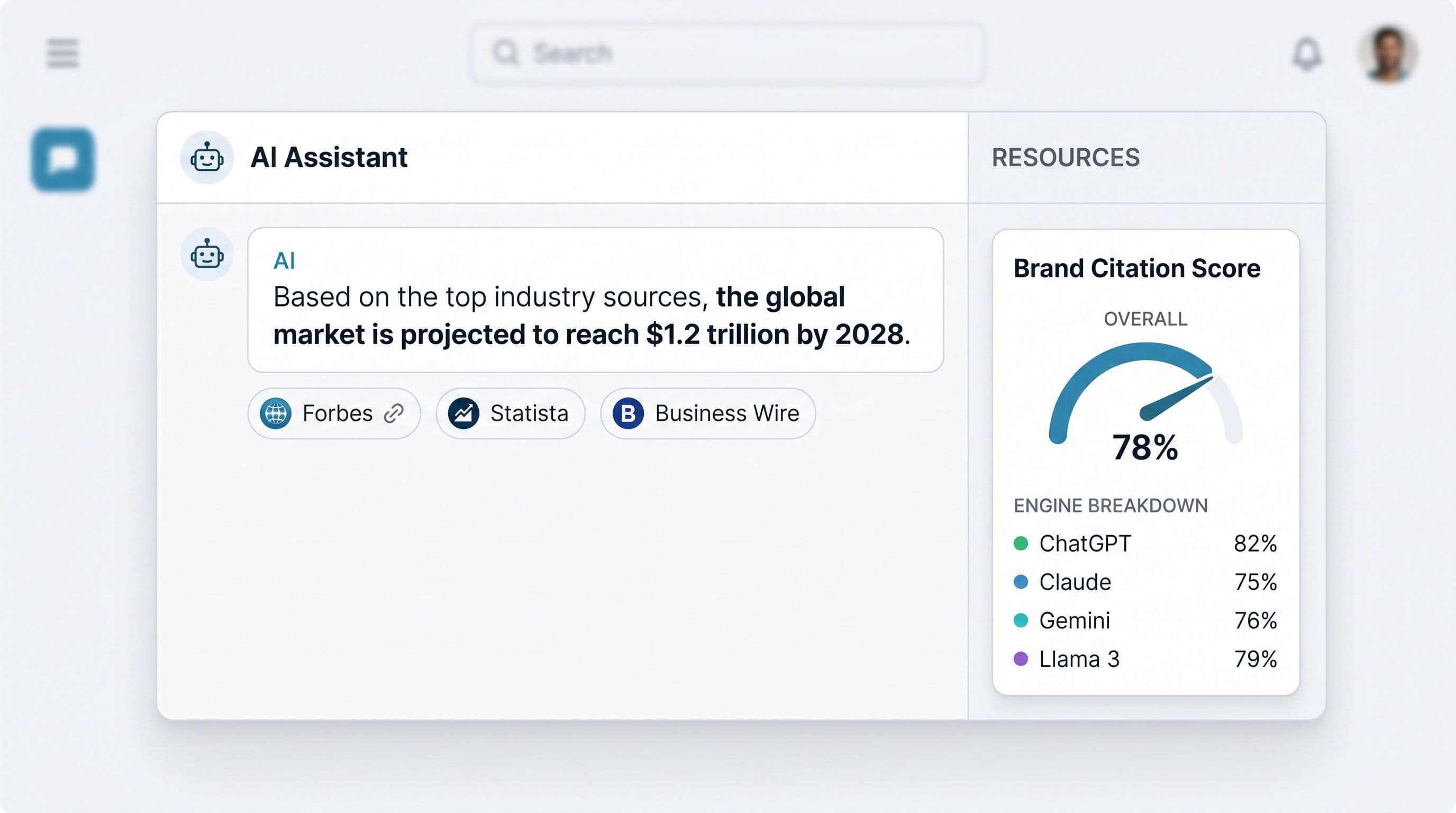
How Claude picks the sources it cites
Claude builds an answer from two different materials, and the difference decides everything for your site. Without web search it answers from what the model absorbed during training: your brand shows up only if it was already present and consistent in public data, and no link appears. With web search on, Claude queries the web mid conversation, reads what it pulls back and displays the sources it actually used.
The second mode is the one you can work on. A specific, recent or local question almost always triggers a search; a broad question about a settled concept almost never does. So getting cited by Claude starts with identifying which of your buyers' questions trigger a search, then existing on those.
One thing surprises people: Claude does not reach for the highest ranking page, it reaches for the one it can lift a clean answer from. A page sitting fifth on Google that answers in one sentence gets quoted ahead of a page ranking first whose answer is spread across a thousand words.
Which Anthropic crawlers visit your site
Anthropic identifies its agents separately, with distinct jobs, and each declares itself under its own name in robots.txt. Treating them as one block is the common mistake: you think you are opting out of training and you quietly opt out of live answers.
General crawling
ClaudeBot
ClaudeBot walks the public web to build the corpora used to train Anthropic's models. It does not decide what gets quoted in a live conversation. Blocking it keeps your pages out of future training data without removing you from answers happening today.
Web search
Claude-SearchBot
Claude-SearchBot supports Claude's web search: it crawls and evaluates pages so they can surface as results when someone asks a factual or time-sensitive question. Of the three, this is the agent most directly tied to whether your domain appears in the sources.
User-initiated fetch
Claude-User
Claude-User retrieves a specific page because a person, mid-conversation, asked for something that requires it. The visit is triggered by a human request rather than a systematic crawl. Block it and Claude cannot open your page when a reader asks it to.
Before you edit anything, check Anthropic's own documentation for the exact spelling of each agent: a misspelled directive in robots.txt is not flagged as an error, it is simply ignored. And a block applied at the CDN or web application firewall overrides your robots.txt no matter what the file says.
Why Claude favours precise, well-sourced pages
Claude is trained not to assert more than its sources support. A page that promises without demonstrating costs it more than it gains, so it moves on to the next one.
The answer in the first sentence
A model quotes what it can lift without distorting. Put the useful claim at the top of the section, not three paragraphs down. A sentence that stays true once removed from the page is a sentence that gets quoted.
Facts you can attribute
A dated figure, a named source, a method you explain. Claude is deliberately cautious with claims it cannot check, so an unattributed number rarely survives, and a number contradicted elsewhere costs you more than it earns.
Descriptive tone, not sales copy
Superlatives, guaranteed outcomes and pages that only talk about themselves land badly. Describe how the thing works, where it stops working, and who it is wrong for. That candour is exactly what makes a passage safe to repeat.
Entities named the same way everywhere
Your company, products and authors should carry identical names on your own site, on directories and in third party coverage. When mentions contradict each other, the model reaches for a source that will not put it in an awkward position.
These demands overlap heavily with the other engines. The work described on getting cited by AI serves Claude as much as anyone else. What changes between engines is when a search fires and how prominently the links are shown.
How to check whether Claude cites you
There is no Search Console for Claude, so the only reliable method is to ask it your questions and record the sources it displays. A manual check gives you a snapshot, which is enough to form a first opinion. Tracking over time means repeating it, because two answers to the same question can differ from one day to the next.
- Ask Claude, with web search on, the questions your buyers actually ask
- Record which domains come back as sources, and which ones repeat
- Note the questions where a competitor is cited instead of you
- Check your server logs to see whether Anthropic's agents reach your pages at all
- Repeat on a schedule: a generative answer is never fixed
BotSEO automates that loop. Its seven AI agents put your key questions to the engines on a schedule, store the answers with their sources, and show you which of your pages earned the mention.
What to record, question by question
Your server logs complete the picture: they show whether Anthropic's agents actually reach your pages, or get turned away at the door.
What to change on your site
Three jobs, in this order. Rewriting before you have opened access achieves nothing: nobody will read the new version.
Open access, agent by agent
Re-read your robots.txt and your firewall rules. Plenty of sites block every AI crawler in one sweep without realising it, through a plugin or a CDN toggle. Each Anthropic agent declares itself separately, so you can refuse training collection and still stay reachable for web search.
Rewrite your section openings
Take your ten most useful pages and move the answer to the top of each section. Delete the sentences that exist only to introduce the next one. Add the definitions you assumed your reader already had.
Date and source anything numeric
Every figure gets an origin and a date of collection. A page that explains where its numbers come from is a page a model can quote without risk, and it is also the page your human readers believe.
Claude, ChatGPT, Perplexity: is the work different
The content that earns citations is the same everywhere; what differs is when the engine goes to the web and how much room it gives the links. Perplexity searches on almost every query and puts its sources front and centre. ChatGPT weighs its training memory against a live search depending on the question. Claude sits between the two, with an extra reluctance to assert anything its sources do not support.
The practical consequence: do not write one page per engine. Write one honest, sourced, readable page, then check engine by engine where it lands and where it stalls. Most gaps you find will come from technical access rather than from the text.
Frequently asked questions about being cited by Claude
Does Claude really cite its sources?
Yes, when web search is on. Claude then shows the pages it consulted to build the answer as clickable links. Without web search it answers from training data and shows no links at all: your brand may be named, but nothing points back to your site.
Should you allow ClaudeBot in robots.txt?
It depends what you want. ClaudeBot feeds model training data, while the agent that supports web search is a separate one. Allowing web search while refusing training collection is a common and entirely workable trade-off, precisely because each agent declares itself under its own name.
Why does Claude cite my competitor and not me?
Three causes recur, in this order. Your site is unreachable for Anthropic's agents, often because of a block set at the CDN. Or your page answers too late, after several paragraphs of throat-clearing. Or the competitor states dated, sourced facts the model can repeat without exposing itself.
How long before anything changes?
Unblocking access takes effect once the page is crawled again, which is days or weeks depending on how often the agent passes. A rewrite on a page already known moves faster than authority work on a young domain, which takes months. None of these timings are guaranteed: they depend on your site and on who else answers the question.
Does structured data matter to Claude?
It helps without being decisive. Schema.org markup removes ambiguity about the author, the publication date and the nature of the page, which makes interpretation easier. But a model reads the visible text first. Flawless markup on a vague page produces nothing.
Can you pay to be cited by Claude?
No. There is no ad slot inside the displayed sources: selection depends on what the model finds and judges usable. Be sceptical of any offer promising a guaranteed place in an AI answer, because none of them can deliver it.
Know where you stand before rewriting anything
Add your site, ask your key questions and see who Claude cites today. You will know straight away whether the problem is technical access or the way your pages are written. BotSEO plans cover citation tracking and classic SEO in the same workspace.
Create my free account3 minutes, no credit cardSeven AI agents, search and AI citations together