Make your site a source ChatGPT quotes.
ChatGPT cites a site when three things are true at once: it can reach the page, it can read it, and it finds a short verifiable answer to the question being asked. The first condition lives in your robots.txt file, where OAI-SearchBot must be allowed, because that crawler feeds the search index behind the sources listed under ChatGPT answers. The other two live in the page itself: a direct answer in the opening lines, entities named without ambiguity, and facts a model can repeat without distorting them.
See if ChatGPT cites me3 minutes, no credit card
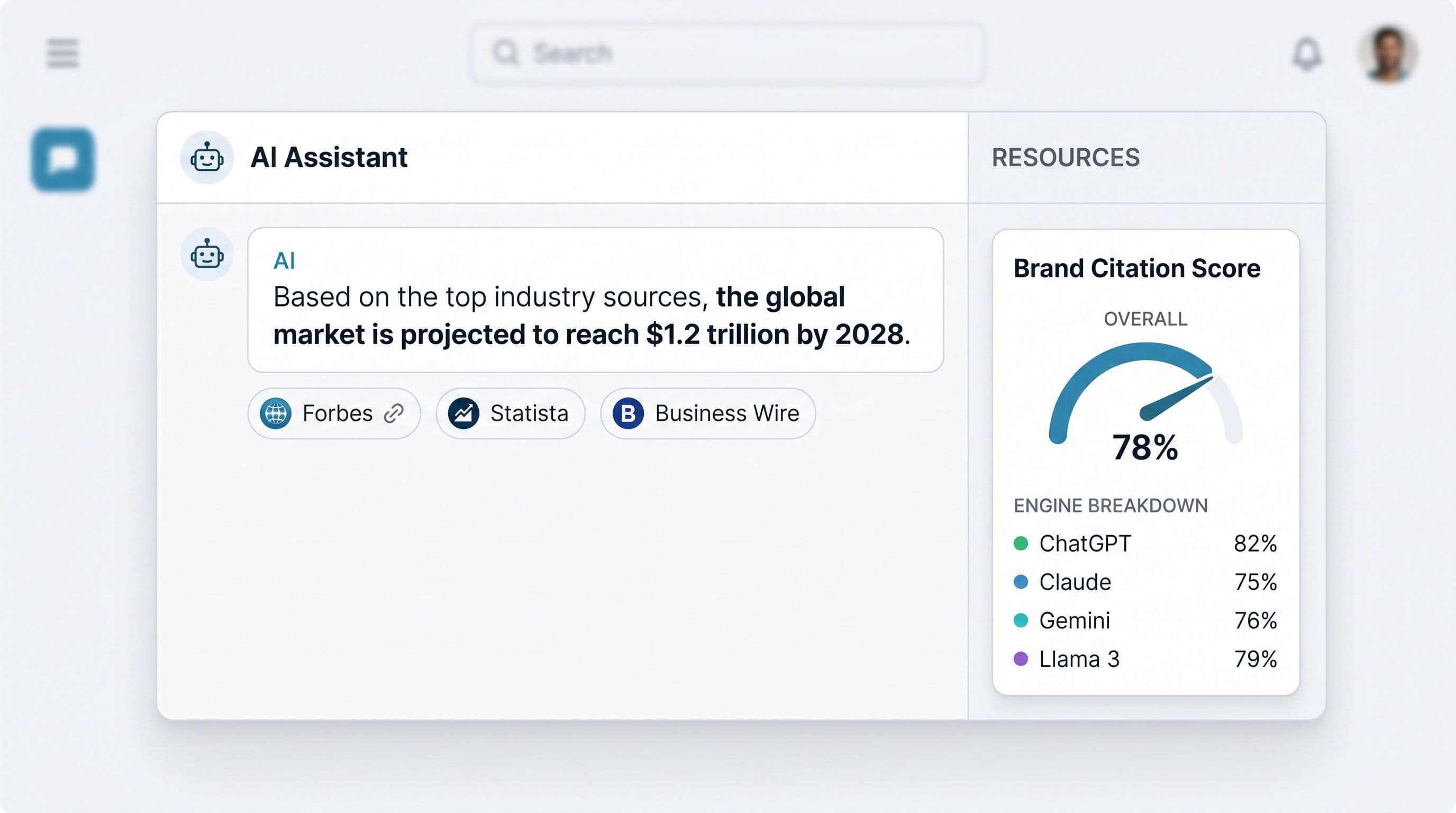
How does ChatGPT choose the sources it cites?
ChatGPT picks its sources at answer time, by running a web search on its own rewrite of your question. There is no fixed list of trusted sites. It queries its search index, pulls back a handful of pages, extracts the passages that answer, then writes a synthesis keeping links to the pages it actually used.
Two modes coexist, and the difference decides everything. With web search active, the answer rests on pages read in the moment, with clickable links. Without it, the model answers from what it learned in training: it can name your brand, but with no source and with freshness capped at its training cutoff.
The same question asked twice does not return exactly the same answer or exactly the same sources. That instability is not a bug to route around, it is how the system works. It means reasoning in citation frequency across repeated checks, never on one test.
OAI-SearchBot, GPTBot, ChatGPT-User: three crawlers, three jobs
OpenAI crawls the web with three separate agents and they do not do the same thing. Treating them as one line in robots.txt is the most common mistake on this topic, and the most expensive.
OAI-SearchBot
The citation crawler.
It builds the search index ChatGPT queries when it browses. A page it cannot reach cannot appear in the sources listed under an answer. If you allow only one OpenAI crawler, allow this one.
GPTBot
The training crawler.
It collects pages used to train the models. Blocking it does not remove you from ChatGPT search results, but it does keep your material out of the background knowledge the model draws on when it answers without browsing. Many sites blocked it in 2023 as a precaution, then blocked the rest in the same commit. That confusion is what costs citations.
ChatGPT-User
The on-demand fetcher.
It retrieves one specific page when a user, or an agent acting for a user, hands over a URL or asks for something to be checked. It does not crawl the web on its own initiative. Blocking it means nobody can read your page from inside ChatGPT.
Why one blocked line cancels all the rest
A site that disallows OAI-SearchBot cannot appear in ChatGPT sources, however good its pages are. The crawler never read the content, so nothing is indexed, so nothing is quotable. It is a silent failure: no alert fires, your Google traffic does not move, and there is no way to notice without going to look.
# Allow citations inside ChatGPT
User-agent: OAI-SearchBot
Allow: /

# Allow on-demand fetches from a user prompt
User-agent: ChatGPT-User
Allow: /

# GPTBot feeds model training: your call
User-agent: GPTBot
Allow: /
Check the layer above as well. A web application firewall, a bot-protection service or a CDN rule can refuse these crawlers before robots.txt is even fetched. In that case the file is perfect and the page stays invisible.
How this differs from ranking on Google
Getting cited by ChatGPT is a selection, not a ranking. Three practical consequences change how the work is done.
Google ranks you, ChatGPT selects you
On Google, position ten still exists: visible, clickable, measurable. In a ChatGPT answer there is no position ten. There are three or four sources kept and everything else nowhere at all. Ranking becomes binary.
The query is no longer the unit
People do not type into ChatGPT what they type into Google. Prompts are long, conversational, often several questions in one message, and the model rewrites them into its own internal searches. Optimising an isolated keyword no longer means what it used to; the whole question is the unit.
There is no Search Console for ChatGPT
OpenAI publishes no dashboard where you can read your impressions or your citations. The only reliable method is to ask the model your own questions on a schedule and record whether your domain shows up in the sources. Measurable, but somebody has to run it.
The same mechanics govern Google AI Overviews, on a different index with different selection criteria. The editorial work carries over; the measurement does not.
What kind of content actually gets quoted
ChatGPT quotes short, self-contained, attributable passages. A model does not cite a page, it cites a fragment it can pull out of context without betraying it.
An answer at the top of the section
A model splits a page into passages and judges each one on its own. A passage that opens with four sentences of throat-clearing says nothing until it ends, so it gets skipped. A passage that answers in two sentences and then develops gets lifted, often verbatim.
Entities named the same way every time
Spell out your brand, products, locations and authors, consistently, in the same places. A model links a question to an entity, not to a string. "We", "our platform" and "the solution" link to nothing at all.
Facts written as facts
A price, a date, a duration, an eligibility rule, a compatibility statement. A short declarative sentence gets quoted; a paragraph circling the point does not. If a figure matters, date it and say where it came from, because a model prefers what it can attribute.
A source it can defend
A named author, first-hand experience, and agreement between what your site says and what third-party pages say about you. When a model is caught between two contradictory sources, it usually reaches for a third, clearer one.
The same principle applies engine by engine: Perplexity cites more readily and more widely, Gemini leans on the Google ecosystem.
How to tell whether ChatGPT already cites you
The only reliable method is to put your questions to the model with web search active and record whether your domain appears among the sources. There is no official console for this; OpenAI does not publish one. Use a fixed question list, run it on a schedule, and keep the history, because repetition is what turns an impression into a measurement.
You can do this by hand in a spreadsheet. It is tedious but instructive, and it holds up for twenty questions. Past that, or as soon as you want to compare engines and tie a gain to a specific fix, the log has to be automated.
- A ChatGPT citation score, tracked over time
- The questions where you appear, and the ones where a competitor appears instead
- The pages on your site the model actually reaches for
- The state of your robots.txt rules for OAI-SearchBot, GPTBot and ChatGPT-User
- Fixes ordered by expected effect rather than alphabetically
What to fix first
- 1
Open robots.txt and check OAI-SearchBot
This is the one that cancels everything else. While the citation crawler is disallowed, no amount of editorial work will produce a result. Check the layer above it too: a WAF, a bot-protection rule or a CDN setting can refuse these crawlers before robots.txt is ever read.
- 2
Rewrite the first paragraph of your key pages
Take the ten pages that carry your revenue and make them answer within the first two sentences. It is the smallest amount of work for the largest effect, because it applies to pages the model already knows.
- 3
Make your facts attributable
Date your figures, name their source, sign your pages with a real author. A model that cannot tell where a claim came from will prefer the source that tells it.
- 4
Measure before you carry on
Put your twenty key questions to ChatGPT, record who gets cited, repeat next month. Without that log you are fixing blind and you will never know which change did the work.
The seven BotSEO agents work from one workspace: technical audit, content, links, rank tracking and generative citation logging. You do not switch tools between the diagnosis and the fix.
What running these checks actually turns up
Accidental crawler blocking is the most ordinary problem and the most underestimated. It rarely comes from a decision. It comes from a line added in 2023 out of caution, a security module on by default, or an agency that left without leaving notes. The site works, Google traffic is fine, and nobody thinks to look.
Second thing: the pages that get cited are almost never the ones you expected. A dry spec sheet, a help article, a forgotten long-form post come up more often than the polished commercial page. The reason is mechanical. Those pages answer; the commercial page persuades. A model is looking for an answer.
Third: when a competitor is cited instead of you, domain authority is rarely the cause. Far more often they wrote down in plain words something you left implicit, a price, a compatibility, a condition. That kind of fix takes an hour and costs nothing.
Frequently asked questions about ChatGPT citations
Do I have to allow GPTBot to get cited by ChatGPT?
Not directly. The sources shown under a ChatGPT answer come from its search index, which OAI-SearchBot feeds. GPTBot exists to gather training data. Blocking GPTBot while allowing OAI-SearchBot is a coherent position if you would rather not feed training but still want to be quotable. The common mistake is blocking both in the same edit.
Can ChatGPT mention me without browsing the web?
Yes, but without a link. When it answers from memory it draws on what it learned during training and may name your brand with no clickable source. That is real visibility, but it is unverifiable and hard to steer. Linked citations almost always come from a web search triggered during the answer.
How long before a change shows up?
It depends on what you changed. A page the engine already knows, rewritten to answer earlier, can change status within weeks because the model is re-reading a source it has seen. Building the authority that gets a brand-new domain quoted at all takes far longer. We do not publish a number here: it would vary too much between sites to mean anything.
Does classic SEO still matter?
More than ever. ChatGPT search draws on pages that already exist in web indexes, and a page invisible in ordinary results has little chance of being kept as a source. Your organic visibility is the raw material; citation work decides what gets made of it.
How do I check whether ChatGPT cites my site?
Ask it your real business questions with web search active and look at the sources listed under the answer. Repeat it regularly, because a generative answer is not stable and a single test proves nothing. BotSEO automates that log and keeps the history, which is what lets you tie an improvement to a specific fix.
Does structured data make a difference?
It helps, and it is not magic. Schema.org markup removes ambiguity about what a page is, who wrote it and which entity it describes, which makes the match between a question and your brand easier. Flawless markup on content that answers nothing will still produce no citations.
More from this series
This page belongs to the get cited by AI series, which covers engine by engine what it takes to appear inside a generative answer.
Finding out takes less time than arguing about it
Enter your site. BotSEO checks your robots.txt rules, puts your key questions to the generative engines, and shows you where you are quoted, where a competitor is quoted instead, and what to fix first.
Run my check3 minutes, no credit cardSearch visibility and AI citations together